5G vs Wi-Fi 6: Key Differences Explained in Simple Words
Your phone shows a 5G symbol at the top. Your new router box proudly says Wi-Fi 6. Both promise faster internet, so it is natural to wonder: are they rivals? Do you need both? The short answer is that they are not enemies at all — they do different jobs. Understanding the 5g vs wi-fi 6 difference will help you spend money wisely and stop blaming the wrong network when a video buffers.
First, What Exactly Is 5G?
5G is the fifth generation of mobile network technology. It is the same family as 3G and 4G that your SIM card has always used. Your phone connects to a mobile tower run by your operator — in India, that means companies like Jio and Airtel. You pay for a mobile plan, and the network follows you wherever coverage exists: on a train, in a market, in another city. For the regulator’s view, see the FCC’s 5G overview.
In simple words, 5G is internet for the outdoors and for travel. The signal comes from towers that may be hundreds of metres away, and it is shared by everyone in that area who is connected to the same tower.
And What Is Wi-Fi 6?
Wi-Fi 6 is a newer, better version of the Wi-Fi you already use at home and office. It is not a mobile network. Your Wi-Fi router takes internet from a wired broadband connection (fibre, usually) and spreads it wirelessly inside your building. Your phone, laptop, TV and smart bulb then connect to that router.
Wi-Fi 6 (technically called 802.11ax) is designed for crowded spaces. Older Wi-Fi versions struggled when many devices connected at once; Wi-Fi 6 handles dozens of phones, laptops and smart devices together far more smoothly, and it also uses a phone’s battery more gently. In simple words, Wi-Fi 6 is internet for indoors, supplied by your own router.
The Core Difference in One Line
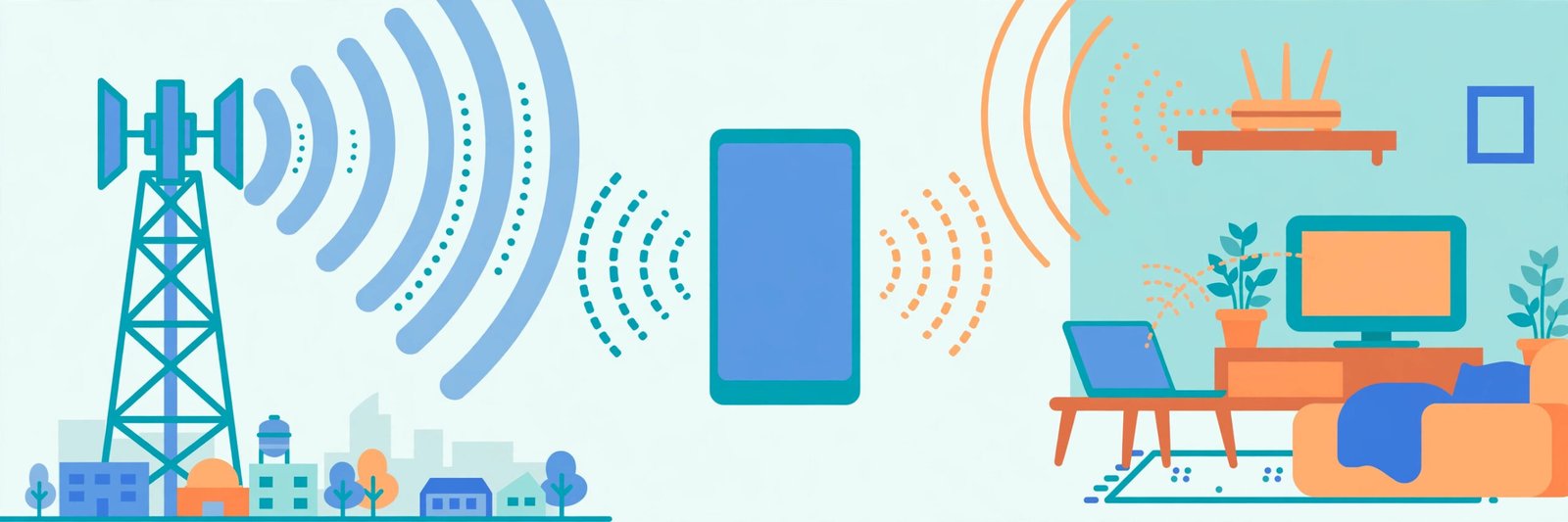
5G comes from your mobile operator’s tower and travels with you across the city. Wi-Fi 6 comes from your own router and stays within your home or office. That single fact explains almost every other 5g vs wi-fi 6 difference below.
5G vs Wi-Fi 6 Difference: Side-by-Side Comparison
| Point | 5G | Wi-Fi 6 |
|---|---|---|
| Type of network | Mobile (cellular) network | Local wireless network |
| Who provides it | Mobile operator (Jio, Airtel, etc.) | You, through your own router |
| Source of internet | Mobile towers | Your broadband/fibre connection |
| Coverage area | Cities and towns, wherever towers reach | Roughly one home or office floor |
| You need | A 5G phone and a 5G plan | A Wi-Fi 6 router and broadband |
| Best for | Travel, outdoors, backup internet | Home, office, many devices at once |
| Extra cost | Mobile recharge/data plan | Broadband bill; router is one-time |
| Signal weakens when | You are far from a tower or indoors deep inside a building | You are far from the router or behind thick walls |
Speed: Which One Is Faster?
Both are fast — far faster than the 4G and old Wi-Fi most people grew up with. In perfect conditions, both technologies can reach gigabit-level speeds, and in everyday real life, both usually deliver speeds that feel comfortably quick for video calls, streaming and downloads.
In practice, your actual speed depends less on the label and more on your situation. A 5G connection near a tower with few users can beat a cheap home broadband plan. A good fibre connection with a Wi-Fi 6 router can beat 5G in a crowded area or deep inside a concrete building. So do not choose a winner by name; judge by the plan and signal you actually get at your location.
Range and Reliability
5G towers cover large areas, so your connection continues as you move around the city. The weakness is that mobile signals can drop inside lifts, basements and the inner rooms of thick-walled buildings.
Wi-Fi 6 has the opposite profile: a short range, usually limited to a home or a floor of an office, but within that range it is steady and unaffected by how many strangers are using the internet in your neighbourhood. Only your own household shares it.
How Many Devices Can They Handle?
This is where Wi-Fi 6 quietly shines. It was built specifically for homes and offices full of devices — phones, laptops, smart TVs, cameras and more — and it manages them together without the slowdowns older Wi-Fi suffered. 5G also supports many users on a tower, but that capacity is shared with the whole area, so speeds can dip at busy times like evenings in a crowded market. If your home is full of smart gadgets, see how smart devices work in daily life.
Cost: What Do You Actually Pay?
With 5G, you pay your mobile operator through recharges or a monthly plan, and you need a 5G-capable phone. With Wi-Fi 6, you pay for a broadband connection every month, plus a one-time cost for the router. For a family where five people use the internet all day at home, one broadband connection with Wi-Fi 6 usually works out cheaper per person than five separate heavy mobile plans.
So, Which One Do You Need?
The honest answer is: most people benefit from both, used in the right place.
- Choose Wi-Fi 6 at home if your family streams, studies and works online together. It is stable, handles many devices and your mobile data stays untouched.
- Depend on 5G outside for travel, field work, and as a backup when broadband goes down.
- In a small office, a good broadband line with a Wi-Fi 6 router is the backbone; 5G is a handy backup, not the main plan.
Notice that the two are partners, not substitutes. Your phone itself switches between them many times a day without asking you — 5G on the road, Wi-Fi 6 the moment you walk in the door.
Frequently Asked Questions
Is 5G going to replace Wi-Fi at home?
Very unlikely. They solve different problems. Mobile networks are built for wide coverage and movement; Wi-Fi is built for cheap, stable internet inside a building. Homes and offices will keep using Wi-Fi for a long time.
Do I need a new phone for Wi-Fi 6?
Your phone needs Wi-Fi 6 support to get its full benefits, and so does your router. Older phones can still connect to a Wi-Fi 6 router normally — they just will not get the extra efficiency. Many mid-range phones sold in recent years already support it; check your phone’s specifications page.
Why is my 5G slower indoors?
Mobile signals weaken when they pass through concrete walls, and they get weaker the deeper you are inside a building. This is normal physics, not a fault. Near a window, or on Wi-Fi, you will usually see better speeds indoors.
Which is safer, 5G or Wi-Fi 6?
Both use strong encryption. Wi-Fi 6 commonly works with WPA3, the modern Wi-Fi security standard, and 5G has its own built-in protections. For daily use, the bigger risk is weak passwords — set a strong Wi-Fi password and keep your phone updated.
Can I run my whole home on 5G instead of broadband?
You can, using a 5G SIM in a suitable router or hotspot, and it works fine for light use. But for a full family with TVs and laptops running all day, broadband with Wi-Fi 6 is usually more stable and economical.
Conclusion
The real 5g vs wi-fi 6 difference is not about which is “better” — it is about where each one works. 5G is your operator’s network that travels with you across the city; Wi-Fi 6 is your own fast, crowded-home-friendly network inside your walls. Use 5G when you step out, Wi-Fi 6 when you step in, and your internet life becomes simple: fast everywhere, without confusion. If your phone is part of that setup, see how to protect your phone from hackers.
Leave a Reply