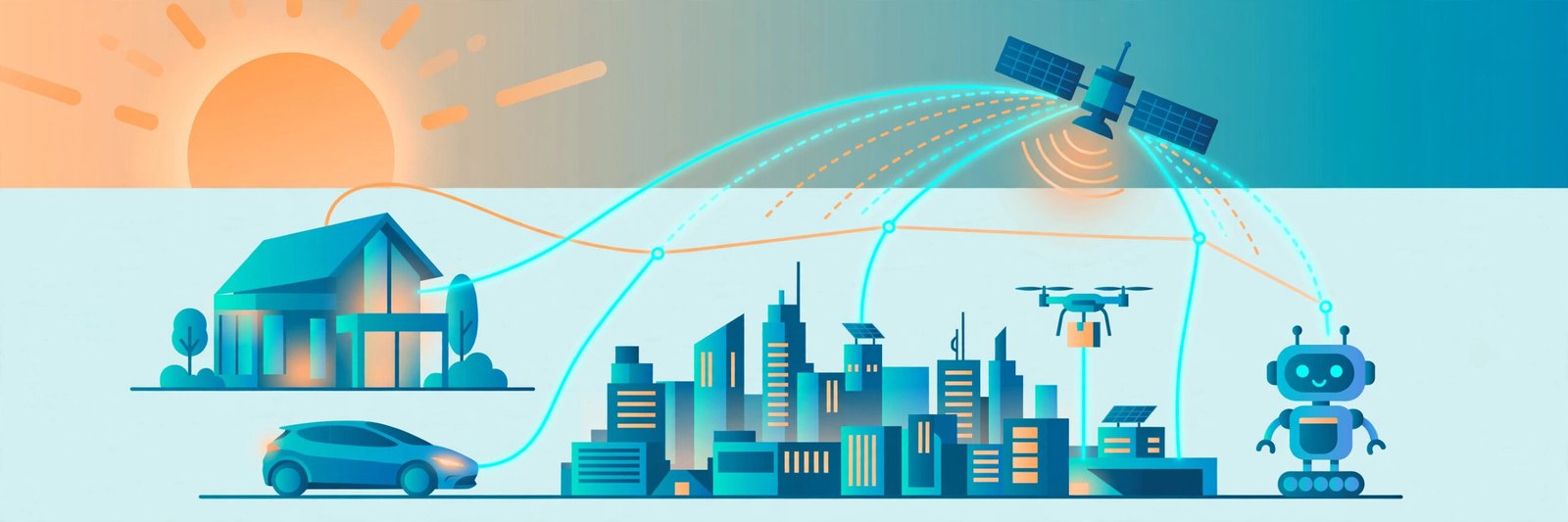
What will your phone, your home and your job look like by the end of this decade? Nobody knows exactly — and any article claiming to know should be read with suspicion. But the direction of travel is visible today. The future technology trends 2030 that experts discuss most are not science-fiction inventions from nowhere; they are extensions of things already around us: AI assistants, smart devices, electric vehicles and instant payments.
This guide walks through those trends honestly, framed as expectation, not fact. Some changes will arrive early, some late, some never in the predicted form. Understanding the direction still helps — it tells you what skills to build and what headlines to take with a pinch of salt.
To judge which of these predictions matter most, it helps to place the future technology trends 2030 in a wider context: our guide to Electric Vehicles in India shows how one of these trends is already reaching Indian roads, and our explainer on What Is Artificial Intelligence covers the technology behind the smartest assistants described above. For an authoritative global outlook, see the World Economic Forum’s Future of Jobs Report. That wider view makes it easier to tell which future technology trends 2030 are hype and which are already reshaping daily life — and which future technology trends 2030 deserve your attention first.
Smarter AI Assistants in Everyday Life
The most certain of the future technology trends 2030 is that AI assistants will handle more routine digital work. Today’s assistants are expected to get better at understanding context, speaking naturally in more languages — including Indian languages — and completing multi-step tasks like drafting, summarising and scheduling on our behalf.
For ordinary Indian users, that could mean a farmer asking questions by voice in his own language, a student getting patient explanations at midnight, or a shop owner letting an assistant draft replies. It could also mean new frustrations: assistants that sound confident while being wrong. Our beginner guide to what artificial intelligence is explains the foundations this trend builds on.
Connected Homes That Mostly Run Themselves
Homes are expected to become quietly more automatic. Lights, fans, appliances and security devices already connect to the internet; the trend towards 2030 is these devices coordinating with each other and with energy prices, rather than each needing separate instructions. A home might prepare itself before you arrive or warn you about a leaking pipe.
This is the Internet of Things growing up — the same idea behind today’s smart watches and TVs, spread across the home. Our guide on what IoT is explains how those devices work. The honest caveat: connected homes will spread first in premium housing, and questions about privacy will not disappear.
Health Wearables and Care From a Distance
Wearables began by counting steps. The expectation for this decade is devices that watch more health signals and flag problems earlier, combined with remote consultations becoming a normal first step. For India, where specialists are concentrated in big cities, a village patient sharing wearable data with a distant doctor could be one of the most meaningful future technology trends 2030 for daily life. Keep expectations measured, though: a watch can suggest, not diagnose. The likely future is wearables helping people reach real doctors sooner — not replacing them.
Electric and Self-Driving Transport
Transport sits at the crossing of two trends. The first — electric vehicles — is already visible on Indian roads and is expected to deepen as charging networks grow. Our beginner’s guide to electric vehicles in India covers how to think about buying one today.
The second, self-driving capability, will probably arrive in layers: driver-assistance features that help with steering, braking and highway cruising are spreading already, while fully driverless travel on mixed Indian roads is a much harder problem that may take longer than headlines suggest. Judge the bold promises by what is actually on sale, not what is announced.
Faster Networks and Internet From the Sky
Each network generation has changed what a phone can do, and work towards even faster, lower-delay networks continues. For most users, the visible change by 2030 may be less about a new label on the phone and more about coverage: quality internet reaching places where it is weak today.
Satellite internet is the other half of this trend. Companies are building satellite networks to deliver internet to remote areas where laying cables is difficult. At concept level, the promise is simple — connectivity independent of local ground infrastructure. Open questions are cost, real-world speed, and regulation, which is why this belongs in the “promising, still developing” category of future technology trends 2030.
Money That Keeps Getting Simpler
Digital payments in India have already moved from novelty to habit. The expected direction is payments becoming even more invisible: paying without pulling out a phone in some settings, and offline options for low-connectivity areas. The other side is fraud growing more sophisticated at the same pace — making habits like strong passwords and 2FA more valuable, not less.
What Future Technology Trends 2030 Could Mean for Jobs and Skills
Every wave of technology deletes some tasks and creates others, and this one will be no different. Routine, repetitive digital work is most exposed to automation. Work that grows in value tends to involve judgement, creativity, trust, and the ability to use new tools well rather than compete with them.
For students and young professionals, the practical reading of the future technology trends 2030 is not “learn one magic skill.” It is: build strong basics in your field, get comfortable using AI tools inside that field, and keep updating. A nurse who understands health data, a mechanic who can service electric vehicles, and a writer who edits AI drafts with judgement are all the same winning pattern.
Hype vs Reality: An Honest Word on Future Technology Trends 2030
Prediction is a business, and excitement sells. Some forecasts here will land early; others will slip by years. Flying taxis have been “five years away” for a long time. Technologies also fail for boring reasons: cost, missing infrastructure, slow rules, or people not enjoying them. The mature way to read any trend is to ask three questions: Is it on sale today, or only announced? Can ordinary people afford it? Does it solve a real problem better than the current way? Trends passing those tests arrive. The rest are entertainment.
Common Mistakes to Avoid When Reading Future Technology Trends 2030
- Treating predictions as fixed facts. A trend is a direction, not a date. Planning your career or a big purchase around an exact promised year is how people get disappointed.
- Buying first-generation hype products at premium prices. Early versions are usually the most expensive and least polished. Waiting often gets you a better product for less.
- Ignoring privacy because a device is convenient. Every connected product collects something. Check what it collects before it enters your home.
- Assuming your skills will stop mattering. Tools change what a job involves; they rarely remove the need for experienced humans overnight. Refusing to learn them is the risky position.
- Panicking about jobs — or dismissing the concern. Both extremes are wrong. Change is real but gradual, and gradual change rewards people who adapt steadily.
Frequently Asked Questions
Which of the future technology trends 2030 will affect India the most?
Probably the combination of wider connectivity, digital payments and AI in Indian languages, because these touch the most people at once — farmers, students, small businesses and patients far from big hospitals. Transport and connected homes will matter greatly in cities but spread more unevenly.
Will robots and AI take all the jobs by 2030?
No serious reading of the trends supports “all jobs.” The realistic picture is tasks changing inside jobs: routine parts get automated while judgement, communication and hands-on work stay human. Some roles shrink, new ones appear, as with earlier waves. The safest skill is learning speed itself.
Should students change what they study because of these trends?
Students should strengthen, not abandon, their foundations. A strong base in your subject plus comfort with digital and AI tools beats chasing whichever course sounds futuristic. Fields change; clear thinking, communication and the habit of learning transfer everywhere.
How can an ordinary person prepare for 2030?
Keep three habits. Stay curious — try new tools early, while mistakes are cheap. Protect yourself — strong passwords, 2FA and scepticism towards too-good offers matter more as everything connects. And build skills gradually, a little every year, instead of waiting for one big change to force it.
Conclusion: Future Technology Trends 2030 in One View
The future technology trends 2030 point in a clear direction — more connected, more automated, more personal technology — even if exact dates and products remain uncertain. For ordinary Indian users, the winning response is neither blind excitement nor fear. It is steady preparation: understand the basics, adopt tools when they genuinely help, guard your privacy and security, and keep learning. The future will not arrive in one day; it will arrive in small upgrades, and people who stay curious will meet it ready.
Leave a Reply