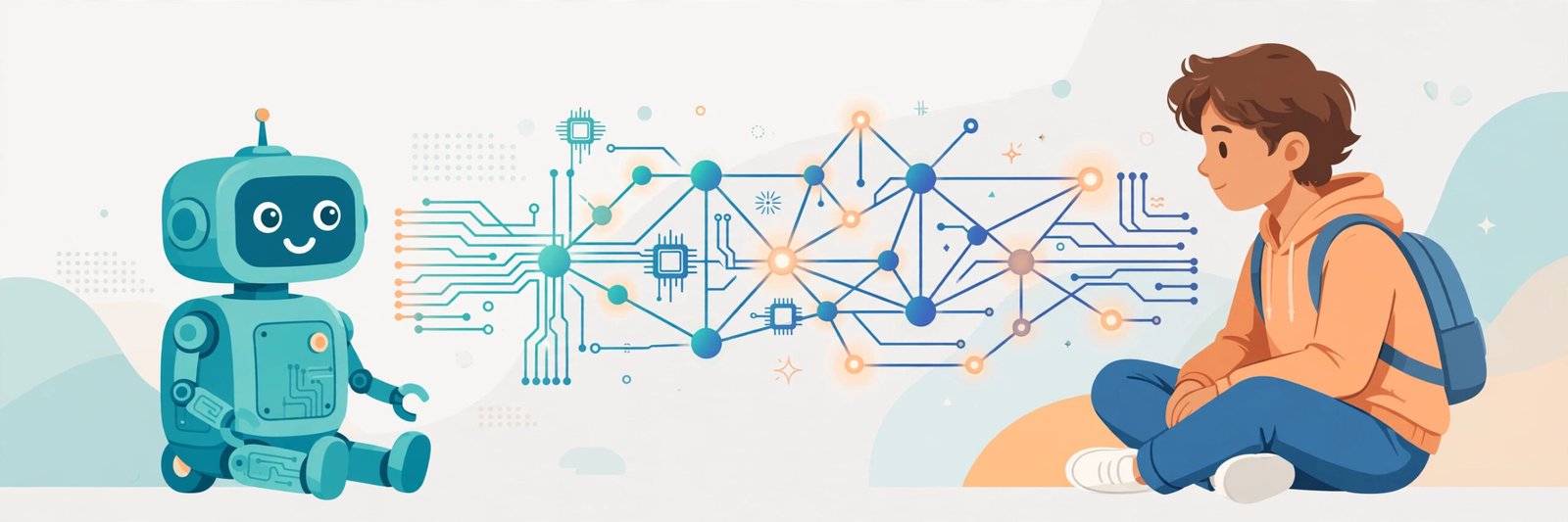
What Is Artificial Intelligence? Simple Guide for Beginners
You unlock your phone with your face. You ask Google Maps for the fastest route, and it already knows where the traffic is heavy. Netflix suggests a show you actually end up liking. All of this is AI quietly working in the background. But what is artificial intelligence, really? If the term sounds complicated, do not worry. By the end of this guide, you will be able to explain AI to a friend in plain, simple words.
What Is Artificial Intelligence in Simple Words
Artificial intelligence, or AI, means teaching a computer or machine to do tasks that normally need human intelligence. These tasks include understanding language, recognising faces and objects, learning from experience, solving problems and making simple decisions. For a formal definition, see IBM’s overview of artificial intelligence.
Think of it this way. A normal computer program follows fixed instructions: if this happens, do that. An AI system is different. It studies a large amount of data, finds patterns in it, and then uses those patterns to make predictions or decisions on new information it has never seen before.
A simple example: a spam filter in your email. Nobody writes a rule for every possible spam message. Instead, the system learns from lakhs of old spam emails, understands what spam usually looks like, and then blocks new spam on its own. That learning from data is the heart of AI.
You Already Use AI Every Day
Most people think AI lives only in robots or science-fiction movies. In reality, you probably use it many times before breakfast.
- Face unlock and fingerprint suggestions on your phone use AI to recognise you.
- Google Maps uses AI to predict traffic and suggest faster routes.
- YouTube and Instagram recommendations learn what you enjoy watching.
- Voice assistants like Google Assistant and Alexa convert your voice into text, understand it, and reply.
- Online shopping sites recommend products based on what people like you have bought.
- UPI apps and banks use AI to spot unusual transactions and warn you about possible fraud.
- Photo apps automatically sort your pictures into people, places and events.
So when someone asks what is artificial intelligence in daily life, the honest answer is: it is already in your pocket. To see these ideas in action, try the best AI tools in 2026.
How Does AI Actually Work?
AI may look like magic, but there is a simple process behind it. Here are the basic steps.
Step 1: Lots of Data
AI systems learn from examples. To teach a system what a cat looks like, you show it thousands of cat photos. To teach it Hindi and English translation, you feed it huge amounts of text in both languages. More good-quality data usually means better learning.
Step 2: Finding Patterns
The system studies the data and finds patterns on its own. It notices that cats usually have pointed ears, whiskers and a certain body shape. Humans do not write these rules; the system discovers them.
Step 3: Making Predictions
Once trained, the AI can look at something new — a photo it has never seen — and predict: “This is most likely a cat.” Chatbots work the same way with words: they predict the most suitable next word, again and again, to build full answers.
Step 4: Improving Over Time
Good AI systems keep getting feedback. When you mark an email as “not spam,” or skip a song you dislike, you are helping the system learn your preferences better.
Main Types of AI You Should Know
Experts divide AI in a few simple ways. Here are the ones worth knowing.
Narrow AI (Weak AI)
This is AI built for one specific task: playing chess, translating languages, recommending videos. Almost all the AI you use today is narrow AI. It can be excellent at its one job, but it cannot step outside it. A chess AI cannot book your train ticket.
General AI (Strong AI)
This is the movie-style AI: a machine that can think, learn and do almost any mental task a human can. General AI does not exist yet. It remains a research goal, not a product you can buy.
Machine Learning, Deep Learning and Generative AI
These three terms appear everywhere, so let us clear them up.
- Machine learning is the most common method of building AI: systems learn patterns from data instead of following only hand-written rules.
- Deep learning is a powerful type of machine learning that uses large layered networks, inspired loosely by the human brain. It powers voice recognition, face unlock and image tools.
- Generative AI is the newest wave. Instead of only recognising things, it creates new content — text, images, music and even video. ChatGPT, Gemini and image generators belong to this family.
Benefits of Artificial Intelligence
Used well, AI brings real advantages:
- Speed: It can read and sort huge amounts of information far faster than a person.
- Availability: Chatbots and tools work day and night without getting tired.
- Help for everyone: Voice typing helps people who find typing hard; translation tools break language barriers, which matters a lot in a multilingual country like India.
- Better services: From farming advice based on weather data to quicker medical report analysis, AI can support experts in many fields.
Limits and Risks of AI
AI is powerful, but it is not perfect, and beginners should know its weak points.
- It can be wrong. AI sometimes gives confident but incorrect answers, especially generative AI. Always double-check important facts.
- It copies bias from data. If the data it learned from was unfair, its decisions can be unfair too.
- It has no real understanding. AI predicts patterns; it does not truly feel, care or understand the world like a person does.
- Privacy matters. AI tools learn from data, so be careful about what personal information you share with them.
- Jobs will change. Some routine tasks will be automated, while new kinds of jobs will appear. Learning to work with AI is a smart move.
Understanding what is artificial intelligence also means understanding what it is not: it is not a human mind inside a machine.
Frequently Asked Questions
Is AI the same as a robot?
No. AI is the “brain” — the software that learns and decides. A robot is a physical machine. Some robots use AI, but most AI lives in apps and websites with no moving parts at all.
Will AI take away all jobs?
Some repetitive tasks will surely be automated, but history shows new technology also creates new work. The safer approach is to learn basic AI tools for your own field instead of fearing them.
Is AI dangerous?
Like any powerful tool, it depends on how people use it. Deepfakes and scams are real risks, which is why governments and companies are building safety rules. For everyday users, basic care — verifying information and protecting personal data — goes a long way.
Do I need coding to use AI?
Not at all. Most modern AI tools work through simple chat boxes and buttons. Coding is needed to build AI systems, not to use them in daily life.
What is the difference between AI and normal software?
Normal software follows rules written by humans. AI software learns patterns from data and improves its answers based on examples and feedback.
Conclusion
So, what is artificial intelligence? In the simplest words, it is technology that lets machines learn from data and perform tasks that usually need human intelligence — recognising, predicting, creating and deciding. It is already part of your phone, your apps and your daily routine. You do not need a technical degree to benefit from it. Start small: try a chatbot, use voice typing, explore an AI photo tool. The more you understand AI, the better you can use it — and the less likely you are to be misled by the hype around it. Many of these tools run on remote servers, so it also helps to understand what is cloud computing.
Leave a Reply