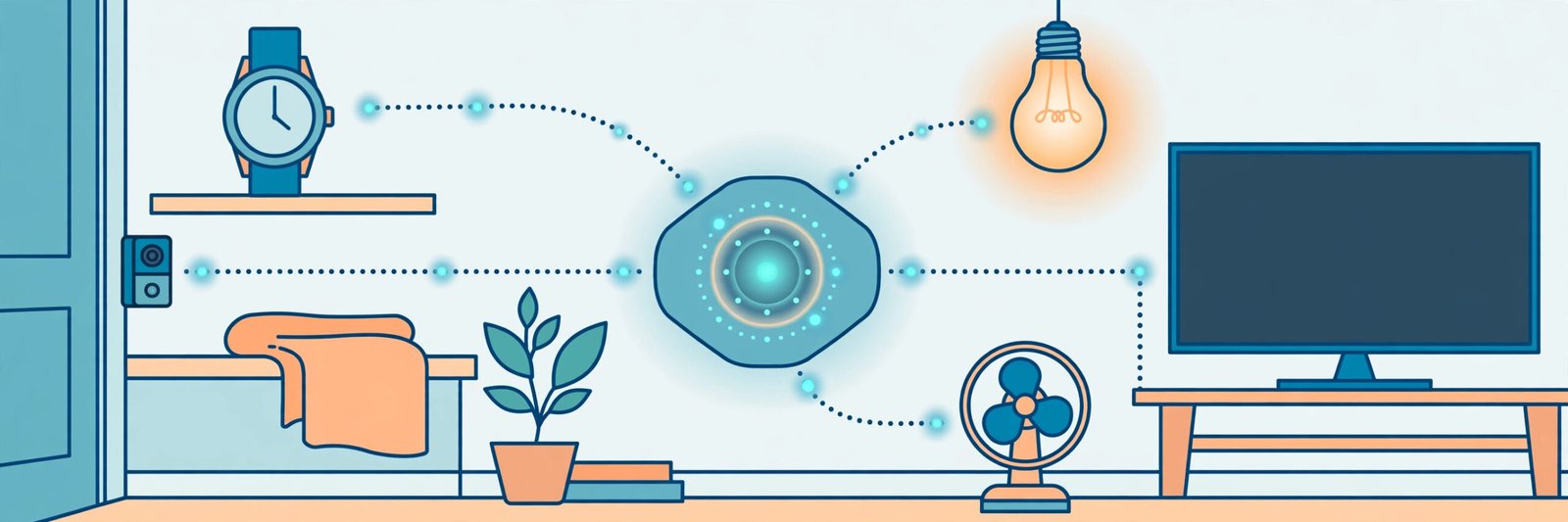
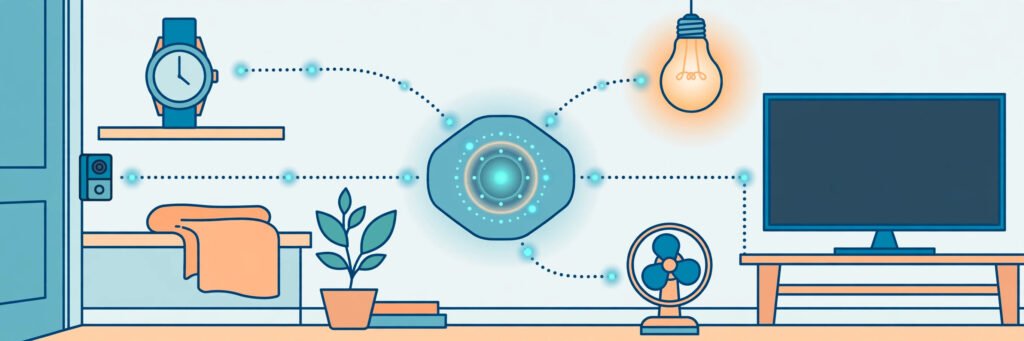
Look around your home and you may already be living with the technology without knowing its name. A watch that counts your steps and shows your heart rate. A TV you operate by talking to a remote. A doorbell that shows visitors on your phone while you are at the office. All of these are small pieces of one big idea — and that idea is the Internet of Things, or IoT.
So, what is iot in simple words? IoT means everyday physical objects — devices, vehicles, home appliances, even farm equipment — that are connected to the internet and can collect information, share it, and sometimes act on it without a human pressing buttons each time. For a deeper technical definition, see Microsoft’s official Internet of Things overview.
A normal fan just spins when you switch it on. A smart fan can sense the room temperature, be controlled from your phone in another city, and switch itself off when you leave. The fan did not change its basic job. It gained senses, a connection, and a little bit of decision-making. That combination is IoT.
The Four Parts Every IoT System Has
To see what is iot in practice, strip away the marketing words: almost every IoT setup has the same four building blocks. Understanding these makes every “smart” product much easier to understand — and to buy wisely.
1. Sensors and Devices — The Senses
Sensors measure something in the real world: temperature, motion, light, location, heartbeat, water level, smoke. A fitness band’s heart-rate sensor, a smart bulb’s receiver, a car’s GPS unit — these are the eyes and ears of the system.
2. Connectivity — The Messenger
The device sends its information somewhere using Wi-Fi, Bluetooth, mobile networks (4G/5G), or low-power long-range networks designed for sensors. This is where your home router, and increasingly 5G, quietly do the heavy lifting.
3. Data Processing — The Brain
The information reaches an app or a cloud server that makes sense of it. “Motion detected at the front door at 9:42 pm.” “Soil moisture is low.” Software compares, calculates and decides what the information means.
4. The User Interface — Where You Come In
Finally, you see the result on a phone app, get an alert, or the system acts on its own — the AC adjusts itself, the water pump switches on, the watch nudges you to walk. Good IoT design means you notice this layer the least; the system simply works in the background.
When people ask what is iot and how it actually works, this chain — sense, send, process, act — is the honest, complete answer.
What Is IoT in Daily Life: Examples You Already Know
At Home
Smart TVs, voice assistants like Alexa and Google Assistant, smart bulbs, video doorbells, robot vacuum cleaners and Wi-Fi CCTV cameras are now common in Indian homes. A smart plug can switch off the geyser you forgot about in the morning — small convenience, real electricity saved.
On Your Body
Fitness bands and smartwatches track steps, sleep and heart rate, and share reports with an app that shows trends over weeks. They are often a person’s very first IoT device, bought for style and kept for the health reminders.
In Health Care
Hospitals and clinics use connected devices that regularly send a patient’s readings to doctors — especially useful for elderly patients living alone or people in remote areas far from a hospital. Wearables that detect a hard fall and alert family members are another real, growing use.
On the Road
GPS navigation, live traffic updates, FASTag toll payments, fleet tracking and cars that report their own service needs all rely on connected devices exchanging data continuously. When your cab’s location moves across the map on your phone, you are watching IoT work.
In Farming and Cities
Some farmers use soil-moisture sensors to decide exactly when to irrigate instead of guessing, saving water and diesel. Cities use connected systems for street lighting, traffic signals, water supply monitoring and waste collection.
Why IoT Matters: The Real Benefits
- Convenience. Control lights, locks, cameras and appliances from anywhere, and automate routines like lights on at sunset.
- Saving time and resources. Systems that switch off idle devices, water only dry soil, or reroute delivery vehicles reduce waste quietly, every day.
- Safety and early warning. Smoke detectors that alert your phone, water-leak sensors, and fall detection for elderly family members can prevent small problems from becoming emergencies.
- Better decisions. IoT replaces guessing with measurement. A shopkeeper who knows which hours are busiest, or a farmer who knows actual soil moisture, decides better than one relying on habit alone.
The Other Side: Privacy, Security and Honest Limitations
A balanced answer to what is iot must include the problems, because every connected device is also a small computer that can be attacked, misused or simply fail.
- Privacy. Devices that listen, watch or track location collect sensitive data. Always check what an app collects, and buy from brands that explain their practices clearly.
- Security. Cheap devices with default passwords like “admin” are easy targets for hackers. Change default passwords, keep device software updated, and secure your home Wi-Fi with a strong password.
- Internet dependence. When the internet goes down, poorly designed smart devices can stop working entirely — including, awkwardly, your lights. Prefer devices that still work manually.
- Cost and compatibility. Devices from different brands sometimes refuse to work together, and replacing batteries across a house full of sensors is its own chore.
None of this cancels the benefits; it just means fewer, better devices beat a home full of gadgets. Keeping that balance is part of living well with what is iot.
Common Mistakes People Make with IoT Devices
- Buying gadgets without a problem to solve. A smart device should remove a daily irritation. If it only adds an app to check, it will be abandoned in a month.
- Keeping default passwords. This is the single biggest security mistake. Change every default password on day one.
- Connecting everything to one weak Wi-Fi password that half the neighbourhood knows. Your network is the gate; guard it.
- Ignoring updates. Device updates patch security holes. Turn on automatic updates wherever the option exists.
- Giving apps unlimited permissions. A smart bulb app does not need your contacts. Review permissions the same way you would on any phone app.
What Is IoT? Frequently Asked Questions
What is IoT in one simple line?
IoT is everyday objects — like watches, bulbs, cars and sensors — connected to the internet so they can collect data, share it, and act on it, often without human effort each time. That is what is iot, stripped down to a single line.
Is a smartphone an IoT device?
Your phone is better understood as the control centre of IoT: it has sensors, connectivity and apps that manage other devices. Strictly speaking, the term usually refers to the “things” around the phone — wearables, appliances, vehicles and sensors.
Does IoT need 5G to work?
No. Most home IoT devices run happily on Wi-Fi or Bluetooth, and many sensors use very little data. 5G helps where huge numbers of devices, fast response or moving vehicles are involved — traffic systems, factories, connected cars — but it is an accelerator, not a requirement.
Are IoT devices safe to use at home?
Generally yes, if you follow basic hygiene: buy from known brands, change default passwords, keep software updated, use a strong Wi-Fi password and review app permissions. Most real-world incidents trace back to skipped basics, not advanced hacking.
What is the difference between IoT and AI?
IoT collects and moves data from the physical world; AI makes decisions and predictions from data. They often work together — sensors in a camera (IoT) capture movement, and AI decides whether it is a person, a pet or just a tree’s shadow.
Conclusion
So, what is iot really? Not a futuristic luxury, and not magic — just ordinary things given senses, a connection and a little software, working quietly in the background of daily life. The fitness band on a wrist, the doorbell that phones its owner, the sensor that waters a field only when the soil is dry: same idea, different costumes.
Start small if you are curious — one genuinely useful device, secured properly, teaches you more than a house full of gadgets. Understanding the simple chain of sense, send, process and act will keep you in control of the technology, instead of the other way around. That is what is iot at its best: ordinary things, quietly working for you.
Leave a Reply